

2026 IDSSD Global Conference Thematic Session
Deep-Sea Chemosynthetic Ecosystems at the Climate–Biodiversity–Resource Nexus
16 July 2026 | 16:50–18:05 | Room XI, UNESCO Headquarters | Hybrid Format
【Introduction】
Deep-sea hydrothermal vents and methane seeps are among the planet’s most extraordinary—and least explored—ecosystems. Powered by chemical energy rather than sunlight, they shape carbon cycling, influence greenhouse gas dynamics, host unique biodiversity, and contain resources of growing economic interest.
At the 2026 Global Conference of the International Decade of Sciences for Sustainable Development (IDSSD), this thematic session will bring together leading international experts to explore how science, innovation, and governance can advance the sustainable stewardship of deep-sea chemosynthetic ecosystems. The session will feature focused synthesis presentations across climate processes, biodiversity, genetic resources, environmental impacts, emerging technologies, ocean governance, and new UN Decade programmes (MOCSI and CliMetS), followed by an interactive dialogue with participants.
【Details】
Title: Deep-sea Chemosynthetic Ecosystems at the Climate-Biodiversity-Resource Nexus: Science, Innovation, and Governance for a Sustainable Ocean Future
Date:16 July 2026
Time:16:50–18:05 (GMT+2)
Venue:Room XI, UNESCO Headquarters, Paris
Agenda:
Time |
Activities |
Speakers |
16:50-16:53 |
Welcome and greeting |
Prof. Peiyuan QIAN (Moderator/Chair)- Chair of the Management Committee of MOCSI and CliMetS, Guangzhou Marine Laboratory - Chair Professor, Hong Kong University of Science and Technology |
16:53-17:05 |
Opening remarks |
Mr. Vidar HELGESEN- Executive Secretary, IOC–UNESCO Ms. Xiaolin GUO- Minister-Counselor of Science and Technology, the Chinese Embassy in France Mr. Shaofeng HU- Director, Division of Science Policy and Capacity Building, Natural Sciences Sector, UNESCO |
17:05-17:10 |
Introduction (Recorded Video) |
Prof. Lisa LEVIN- Co-founder, DOSI Distinguished Professor Emerita, Scripps Institution of Oceanography, University of California, San Diego - Member of the National Academy of Sciences |
17:10-17:45 |
Synthesis presentation-7 topics:
|
Prof. Samantha JOYE- Athletic Assoc. Professor of Arts & Sciences/ Regents' Professor, University of Georgia Prof. Stéphanie DUPRÉ- Researcher, Infremer Prof. Marcel JASPARS- Chair in Chemistry, University of Aberdeen Dr. Virginie TILOT- Attaché Honoraire, Muséum National d'Histoire Naturelle Ms. Yun SUN- Programme Specialist, IOCAFRICA-UNESCO Dr. Pierre METHOU- ATER, Muséum National d'Histoire Naturelle Prof. Jingchun FENG- Programme Director of MOCSI Professor, Guangzhou Marine Laboratory |
17:45-18:00 |
Interactive discussions/Q&A |
|
18:00-18:05 |
Closing |
Ms. Alison Clausen-Programme Specialist, Marine Policy and Regional Coordination Section, IOC–UNESCO |
Poster:
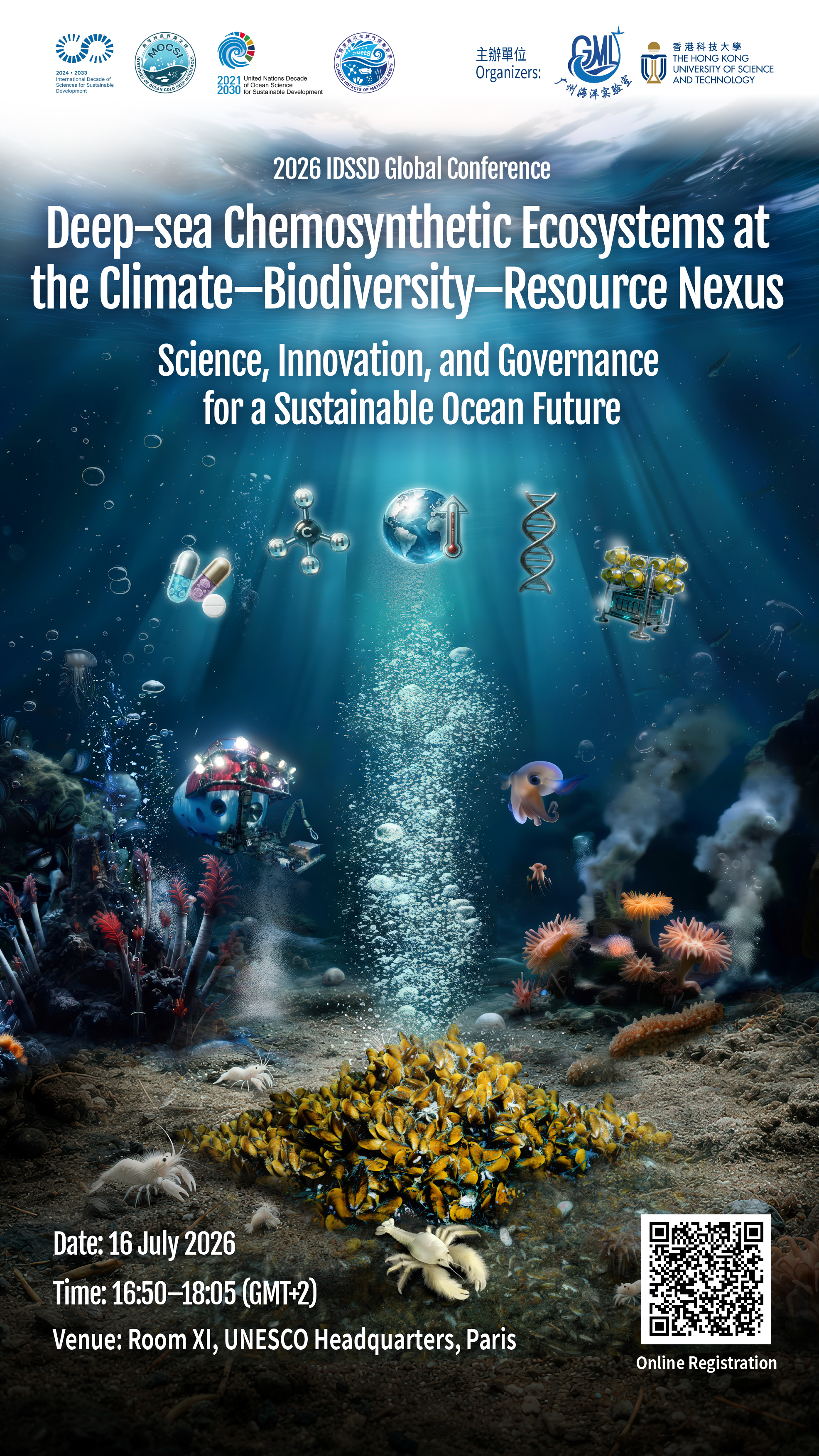
We warmly welcome in-person attendance for those joining the IDSSD Global Conference at UNESCO Headquarters. The session will also be held in hybrid format, enabling global participation online.
To attend virtually, please register through the QR code/link provided by the Science Decade Secretariat. The time shown on the registration page will automatically adjust to your local time zone. When registering, please select the final webinar on 16 July, which corresponds to our session.
Register now
|
Image

|
https://unesco-org.zoom.us/webinar/register/WN_REcbpTeeRDKr7zdpJypUTg |